

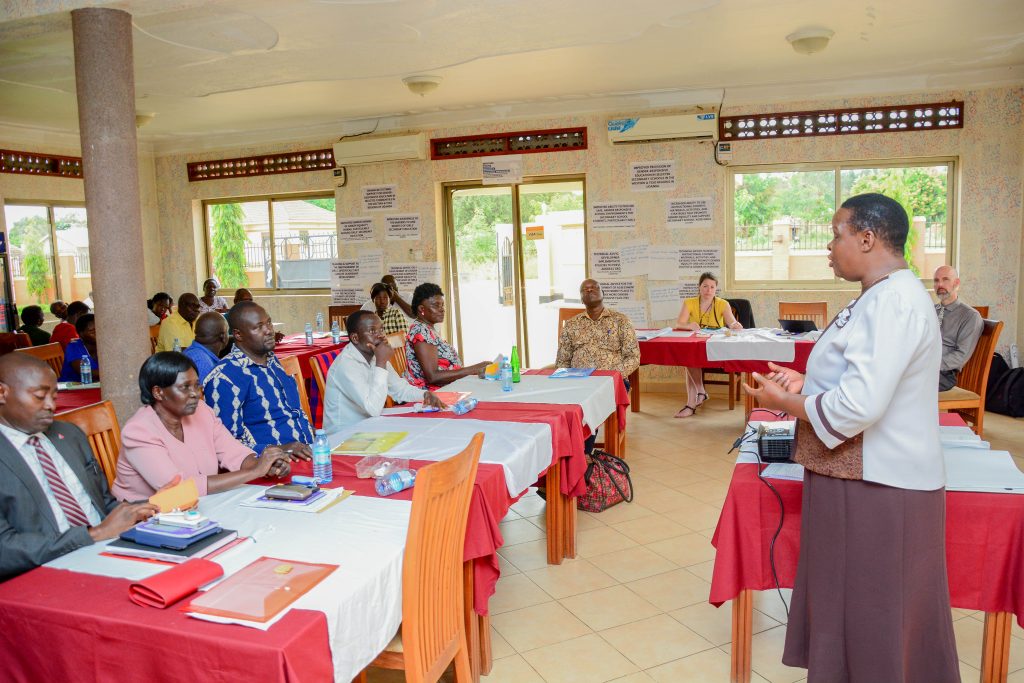
23rd May 2025 | Tooro Royal Cottages, Kyenjojo — As the Simameni Project nears its conclusion, key education stakeholders from Kibaale, Kyenjojo, Kamwenge, and Kyegegwa districts convened for a high-level engagement workshop to reaffirm their commitment to sustaining the Simameni Project in their communities. The event brought together headteachers, District Education Officers (DEOs), Local Government officials, PTAs, Boards of Governors, religious leaders, cultural leaders, Community Development Officers, UNATU General Secretary, Western Regional Chairperson,Branch chairpersons from the 4 districts, and Simameni focal persons.
Opening the Dialogue: Unity, Reflection, and Continuity
In his welcome remarks, UNATU Regional Chairperson Mr. David Mugyenyi thanked stakeholders for embracing and implementing the Simameni initiative in their schools and communities. Acknowledging the project’s closing phase, he urged them to become ambassadors of Simameni and promote the values beyond the current scope. He called for the development of tracking frameworks for learners, encouraged follow-up on SRGBV issues, and proposed extending Simameni-inspired practices to non-implementing areas. He appealed to religious leaders and community actors to integrate Simameni messages into their platforms, emphasizing: “Continuity is our collective responsibility.”
 The Regional Chairperson Mugenyi David giving his remarks
A Project Rooted in Partnership
Officially opening the workshop, UNATU General Secretary Mr. Baguma Filbert Bates shared the origin of the Simameni Project, highlighting the longstanding partnership between UNATU, the Canadian Teachers’ Federation (CTF), and Global Affairs Canada. He reiterated that Western and Teso regions were selected for piloting the project, with four districts each actively engaged.
He emphasized that stakeholder capacity has been built, and called for sustainability through collaboration. Speaking on SRGBV, he noted that “no one is truly safe unless all learners are safe,” pointing out that the COVID-19 pandemic revealed how school can offer more protection than home for many children. He also discussed the importance of psychosocial support, especially for men and learners dealing with stress and pressure from home.
Mr. Baguma commended the headteachers and schools for their commitment and highlighted Simameni’s tangible achievements: improved enrollment, especially for girls, distribution of scholastic and sanitary materials, and training outcomes. He encouraged stakeholders to “carry the spirit of Simameni into future planning and decision-making processes.”
 The general Secretary opened the workshop
The State of Girls’ Education: Progress and Gaps
Ms. Ampaire Grace, Education Officer for Special Needs in Kyegegwa District, delivered a data-driven presentation on the status of girls’ education in Simameni-implementing schools. She traced the historical exclusion of girls in Uganda’s education system, noting early barriers such as cultural norms, limited female role models, and policy gaps.
She outlined government efforts like Universal Primary and Secondary Education, the Affirmative Action policy, and infrastructure development which have improved access. Yet, challenges remain. In Simameni schools, current data shows:
•32% of girls transitioned to S.1, and just 27% of them completed S.4.
Ms. Ampaire urged stakeholders to reflect on the barriers to transition, such as early pregnancies, poverty, and infrastructure deficits. “Educate a girl, and you educate a nation,” she concluded.
Addressing Gender-Based Violence: Prevention and Responsibility
In a session delivered by the Child and Family Protection Unit (CFPU), Kyenjojo, stakeholders were guided through the types and manifestations of GBV, including defilement, sexual harassment, and verbal abuse. The CFPU officer emphasized that exposing children to inappropriate behavior or language is also a form of violence. Visuals of physical violence were used to provoke critical reflection, and participants were reminded that psychosocial support and third-party intervention are often necessary.
Participants were called upon to report all cases of violence through the appropriate school, community, and district structures. Emphasis was placed on empowering women, building strong family units, and encouraging both men and women to speak out and share responsibilities at home. The officer noted, “It’s everyone’s responsibility to protect children and break the silence on GBV.”
Norms, Rights, and Equality: A Shared Responsibility
Ms. Joan Aja, UNATU Gender Officer, presented on Gender Equality Norms and Rights, exploring the invisible social expectations placed on men and women. She challenged participants to confront harmful stereotypes—such as women being solely caregivers and men being discouraged from expressing vulnerability.
Ms. Aja outlined key gender equality rights including equal pay, access to education, and freedom from discrimination, and urged all stakeholders to work toward empowering both girls and boys with the same freedoms and opportunities. “What affects women also affects men,” she stated, encouraging more inclusive family support structures and mutual understanding. Ms. Aja concluded with a firm call to action: that stakeholders must continue to challenge cultural attitudes, promote girls’ education, and ensure the policies around gender equality are not only known—but practiced. She encouraged all present to be intentional agents of change, promoting environments that are safe, inclusive, and empowering for every learner.
Dialogue and Way Forward
A lively Q&A session was moderated by Ms. Mujugu Miriam, UNATU National Representative for Teacher Education. Stakeholders contributed ideas on positive parenting, quarterly GBV reporting, dialogues with religious leaders, and sustainability planning with local governments.
Key action points included:
•Promoting safe and inclusive school environments,
•Continuing SRGBV awareness and sex education at school and community levels,
•Creating Simameni clubs and integrating them into school budgets,
•Providing basic needs and addressing long-distance travel risks for girls,
•Advocating for school re-entry of pregnant learners,
•Radio talk shows, local government dialogue, and quarterly data collection on GBV.
Closing Remarks: Reflect, Implement, Sustain
In her heartfelt closing remarks, Ms. Pelucy Kyaligonza, former District Education Officer for Kyenjojo, extended her appreciation to CTF, Global Affairs Canada, UNATU, and all school leaders. She acknowledged the consistency and growth seen through Simameni, urging stakeholders to carry forward its values.
Reflecting on her own journey as an educator since 1983, she reminded participants that the issues discussed are not new, but what matters now is implementation and personal accountability. “Society is watching us. Let’s play our roles with integrity,” she said. She called on the stakeholders to be ambassadors of the project and to think beyond the end of Simameni — toward sustainable impact in every school and every home.






Did the government increase the salary
Incidentally they have not yet pronounced themselves on it